 Do you remember playing that game as a child — telephone tag?
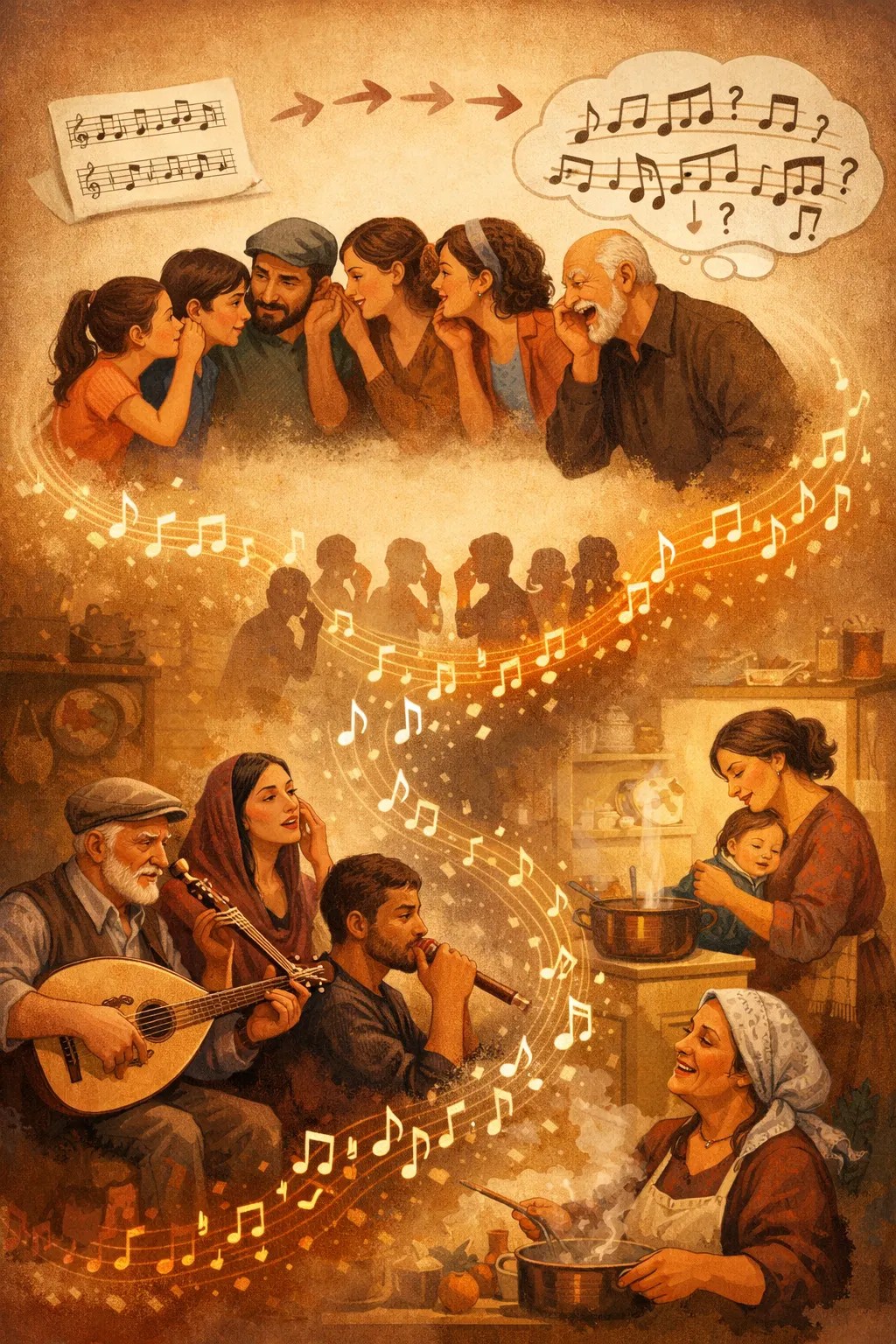
Someone would whisper a sentence into the ear of the person next to them, and it would move around the circle, one person at a time.
By the time it came back to you, the sentence was completely different from what you started with.
Everyone would laugh.
Because the message had been distorted.
Because it wasn’t perfect anymore.
I think about that game often when I think about traditional music — especially Armenian music.
There are so many songs that were never written down.
Not because they weren’t important, but because they didn’t live on paper.
They lived in people.
They lived in kitchens, in weddings, in courtyards.
In the way someone hummed while working, cooking, or rocking a child to sleep.
These songs were passed from one person to another — just like that childhood game.
One voice to the next.
And of course they changed.
A note stretched a little longer.
A phrase got shortened.
Someone forgot a line.
Someone added a new one.
I’ve felt this tension very clearly when performing with musicians who didn’t grow up inside this tradition.
At times, I’ve played with non-Armenian musicians who learned a particular song from an LP recording. They learned it carefully and respectfully, exactly as it was recorded.
And when we rehearsed, they would sometimes get frustrated with me.
Because I wasn’t playing it exactly the way it sounded on the record.
For them, that recording was the song.
That was the correct version.
And I would have to explain — gently — that what they were hearing on that LP was only one moment in time. One interpretation. One person’s memory of a song that had already lived many lives before it ever reached a microphone.
In this music, interpretation isn’t a mistake.
It’s part of the language.
Improvisation isn’t decoration.
It’s participation.
Writing music down — or recording it — preserves it, and that matters. But it also freezes it. It quietly suggests there is one version that all others should defer to.
In oral tradition, variation was never failure.
It was proof the music was alive.
Two people remembering the same song differently doesn’t mean one of them is wrong.
It means the song kept moving.
Just like in that childhood game, the message didn’t survive because it stayed the same.
It survived because it was carried.
Sometimes we focus too much on recovering the “original” version of a song, as if there were only one correct way it was ever meant to sound.
But maybe some songs were never meant to be fixed.
Never meant to be locked into a single form.
They were meant to be remembered — imperfectly, differently, humanly.
When I play these songs now, I’m not trying to recreate them exactly as they once were.
I’m trying to do what they’ve always done.
Carry them forward.
And maybe — just like that game we played as children — the beauty isn’t in how close we stay to the original, but in the fact that something meaningful made it all the way around the circle at all.


You must be logged in to post a comment.