Basement Records: A Story about Dino Pappas

Music Journalist Chronicles The 'Wild Obsessive Hunt' For Rare 78 RPM Records

Music Journalist Chronicles The ‘Wild Obsessive Hunt’ For Rare 78 RPM Records

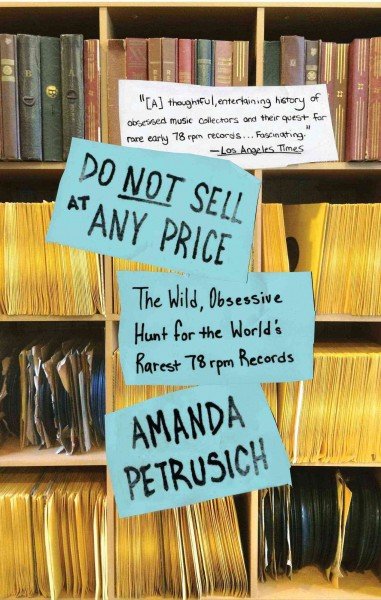
Recently I was listening to the Fresh Air program on NPR and they had a great story about an author who wrote a book about collecting the most rare 78 RPM recordings from around the world. Recordings that would be over 100 years old from different countries. Amanda Petrusich discusses what record collectors will do to go to great lengths in finding these old recordings. “Some, she says, have been known to take jobs specifically because they allow access to strangers’ basements, where rare records may be collecting dust”.

I could not help but to be immediately reminded of an old friend of mine named Gust J. “Dino” Pappas.
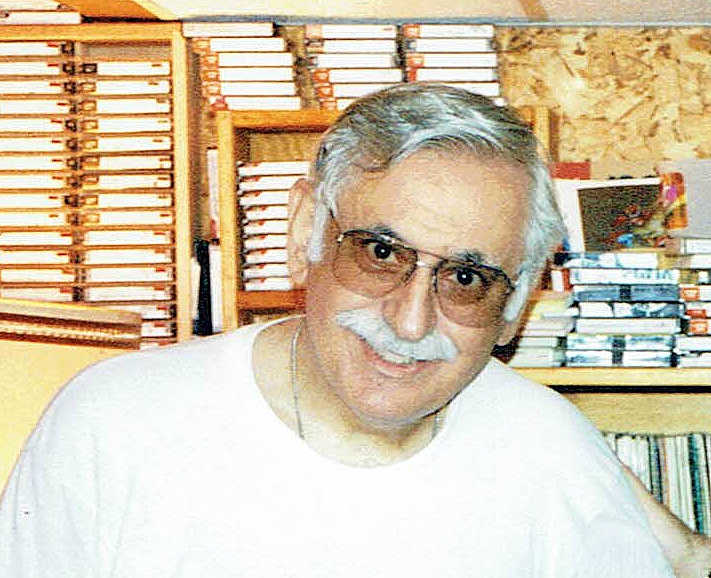
Dino Pappas

Dino Pappas

Dino was a retired Detroit police officer that was an extraordinary collector of music. He was a proud Greek American and his first passion was for the music that his parents and grandparents grew up listening to in “the old country”. First and foremost, Dino loved his Greek folk music. Equal to the music of his country he loved to listen to both Turkish and Armenian music. He never mixed politics with music and even though he was passionate about the atrocities the Greeks endured by the Turkish government, he still loved the music.

He was well known throughout the country as “the” record collector in many circles including the Greek dance community. He most possibly had the largest collection of Greek, Armenian and Turkish 78rpm records in the world.  At one time he told me that he had 10,000 records in his collection.

I first met Dino when I was in my mid-20’s and he lived about 45 minutes from my house. I would, until 1999, spent many hours with him at his house. I would go over to see him and his wife Ann mostly on the weekends and spend hours with him just sitting in a chair in his basement listening to music that he would happily play for me.

I’ll never forget the first time I met him and he invited me into his basement. A treasure chest of recordings to any musician like myself or record collector. One of the first things he told me (that I never forgot) was if I was just interested in coming over once or twice to “use” him to get copies of music he was not interested in continuing the friendship. He would tell me stories of musicians that merely wanted to use him as a library when they needed songs to learn for live gigs. That was not my intention and I made that clear to him. However, and perhaps this came from his years in law enforcement, he wanted to see it and not just take my word. It did not take long for Dino to realize I was genuine in my desire to listen and learn and spend time with him – ultimately calling him a friend of mine.

45 years my senior, Dino took me in like a son or nephew. Many times when I would show up at the house, he would have me go with him to the store to pick up lunch and we would return to his house and sit in his kitchen with his wife and enjoy a sandwich and conversation.
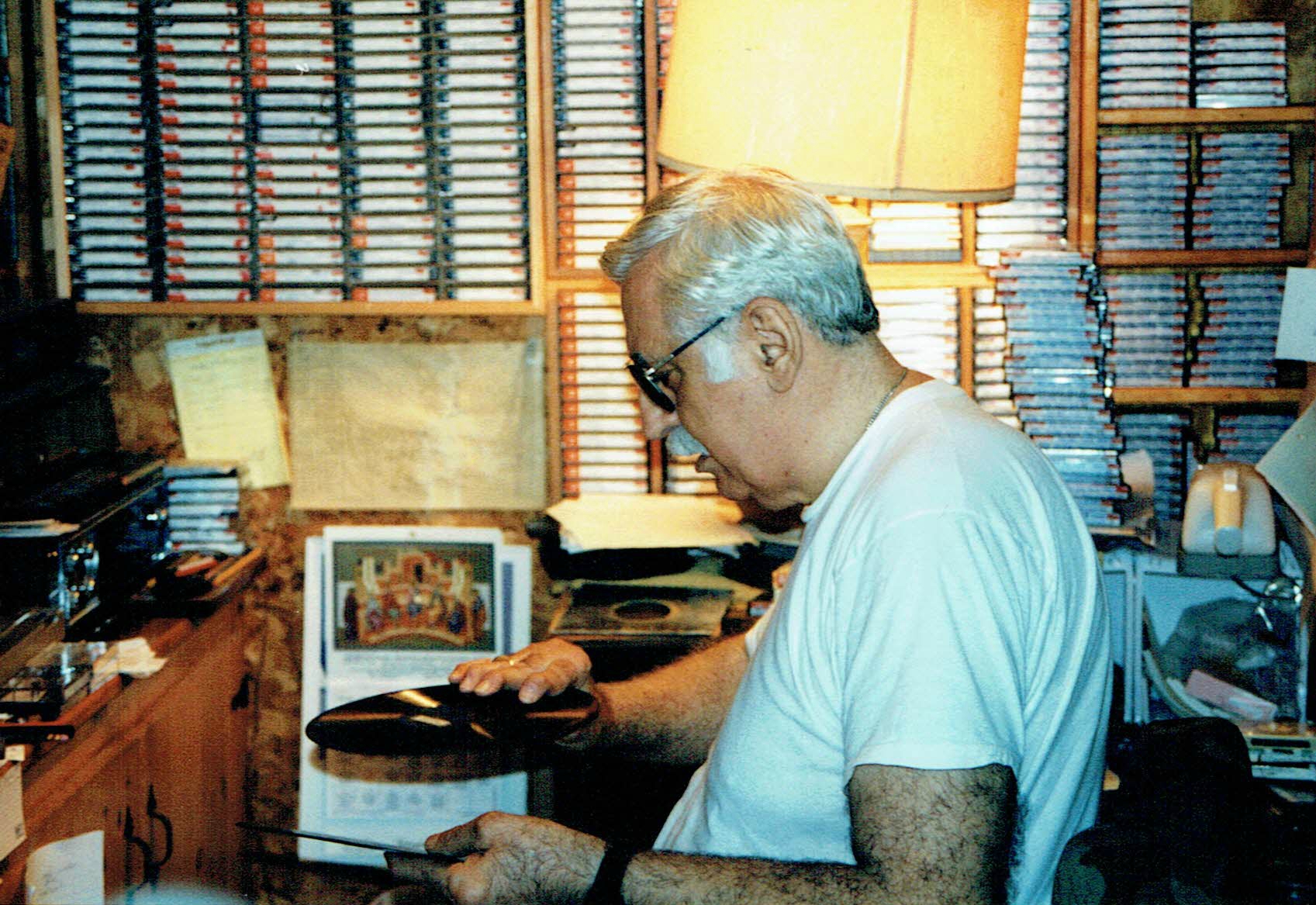
DinoPappas3

Dino in his element, playing records for me. This was my vantage point when I would sit in the basement.

Dino was ever so colorful in his conversations with me and I always enjoyed his frankness and sometimes inappropriate comments. Some have said he could be rough around the edges but to me, we had a good relationship. Here was a guy that thoroughly loved to listen to music and he could do it all day and  night. It was more than a hobby of his it truly was a passion and something that gave him a great amount of joy.
DinoPappas4

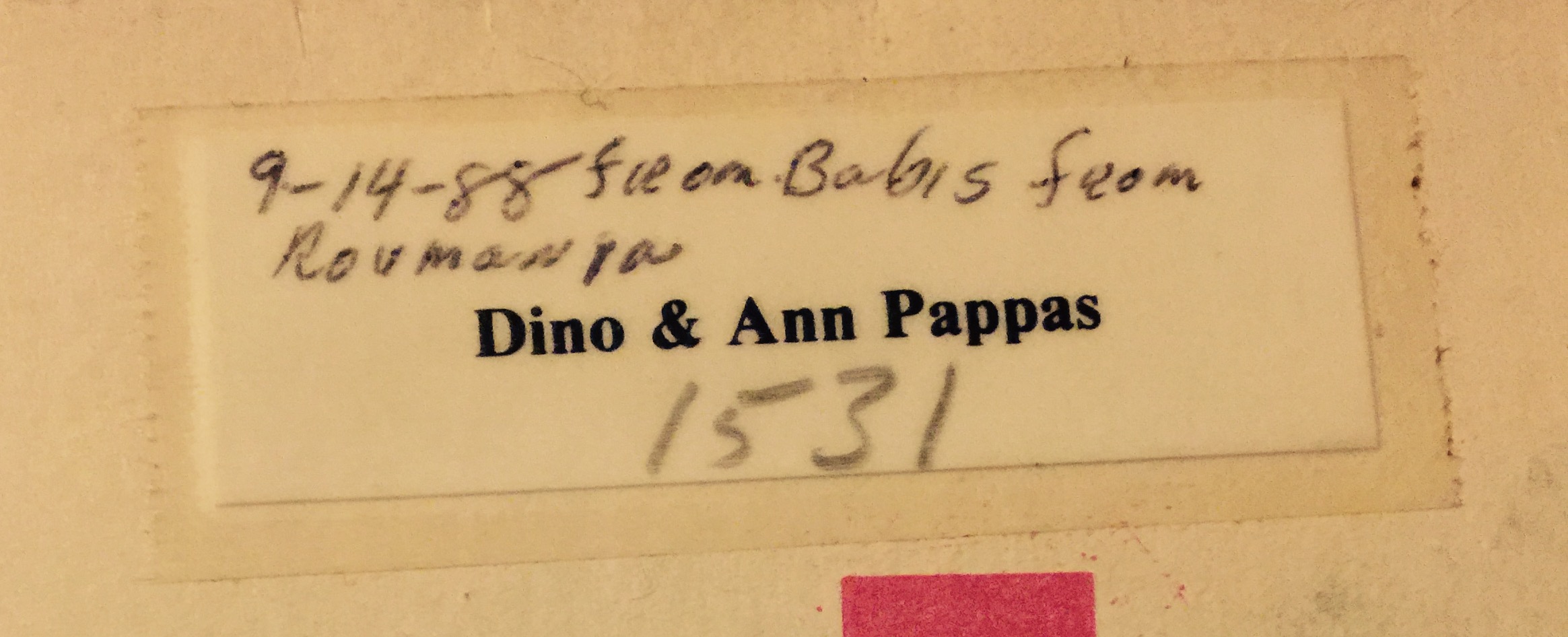
A glimpse into how Dino would catalog his records.

He was an encyclopedia of knowledge when it came to Greek and Turkish music. Way before computers Dino would document every recording with hand written notes that included catalog numbers record label names and performers. Dino even would write down how he came to own a particular record! He used to write them on loose leaf paper and put them in three ring binder’s which were carefully placed a bookshelves in his basement. He knew where to find any song within his collection.

Those visits are still vivid in my memory. His basement was wall-to-wall recordings. He had CDs, cassettes and even rare Greek piano rolls. If that wasn’t enough, he would have duplicates of some of his more precious or favorable recordings.  I can still picture it today sitting in a metal folding chair in his basement for 7 to 8 hours while he sat and DJed for me anything I wanted to hear. We never came up for air -he had a full bathroom in basement and so there was almost never a need to see the sun! Many times when we would emerge from the basement, it was pitch dark outside. On occasion, he would yell up to check on his wife.

Fluent in Greek, it was extra special to hear him play a record and translate the lyrics to me. Musicians from around the world would contact him as he was considered a major resource for music. Several CD releases include his name in the credits for providing material to musicians in order to learn songs.  If the singer was looking for a folk song or instrumentalist was looking to learn different forms of music, Dino was the guy.
DinoPappas5

The logo we used on three recordings of 78rpm releases.

As our friendship grew, we often talked about giving him the proper dedication to the years of efforts in collecting music. Eventually this would lead me to produce three recordings under the series called Dino Pappas Archives. It was my way of giving him credit for preserving so much music, it was my way to show others how important he was to me and how important he was to the musical community. We were both proud of these releases.

I was proud to call him a friend and I was fortunate to have known him prior to getting married and having a family, this made it easier for me to visit him in those days. When musician friends of mine would come to town, part of the agenda always included bringing them to Dino’s house.

As I got older and as time can get in the way of things,  going to Dino’s house was not as frequent. I certainly could count on the phone call where he would lovingly admonish me for not coming over to see him. This would often result in me changing some of my plans to go over to his house and spend the day with him.

One day I got a similar call from him but I noticed that his tone was different this time. He wanted me to come over to the house almost immediately as I had not been there in a couple weeks. What was different about that conversation was one of the last sentences he said to me which was “you know I’m not going to live forever!” At the time, the comment was odd, but not totally out of the realm of something he would say to me. We ended the call that I promised to come over very soon. I never made it.

Later, I found out that Dino had a doctors appointment where he was informed that his heart was not well. I don’t believe he told too many people and sadly I received a call that he had passed away.

I have not forgotten about you Dino. I promised to stay a friend of yours and still appreciate all you did for me. In many ways, you helped me appreciate our traditional village music.

Posted in Uncategorized | Tagged , , , , , , , , , , , , , , , , , | 6 Comments

How people get inspired

Have you ever wondered how people get inspired?

Inspiration is definitely the mother of invention. Everything that we see which has some form of greatness, had to be inspired. Whether it was the invention of different forms of transportation or architecture, the process almost always begins with an inspiration.

I have often wondered how artists become inspired. What process do they go through before they create?

inspiration_signEven as I’m writing this blog, I’m doing so on my mobile device (using a voice activated app) while I’m walking in my neighborhood at 5 o’clock in the morning. Just ran into a neighbor grabbing his newspaper where he commented that I was up very early and certainly it’s pitch black outside. I quickly remarked that this was the best time to go for a walk. As I walked away I thought more about my comment and for me – this early hour is the best time for me to “create”.

As a musician I don’t feel that I create music in the definition musical composition, even though I think most musicians aspire to compose in one way or another. I’m sure the argument could be made that by playing music and playing different styles in the way I do, it is indeed composing music.  However, I think creating an entire composition would be a wonderful process for me. As a musician, composing is definitely on my bucket list of things to do. Getting back to the original theme of this blog essay, the first thing that I think about is how does one become inspired to compose a piece of music?

Where does one go to be inspired what does one have to do to have spontaneous inspiration? Is it the environment that they are in or does one have to seek out a venue or opportunity in order to become inspired?

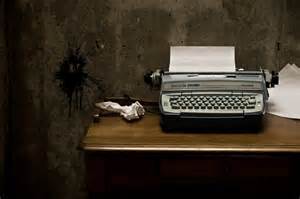
thI used to think that I would have to create my own environment in order to be inspired. For me this would mean to totally disconnect from current surroundings. Almost a satirical look at how writers lock themselves in the room with the typewriter and a ream of paper and sit and stare at the machine hoping the words will pop out of their head and onto the paper.

I know of musicians that will keep a recorder with them at all times so that an idea of a song comes to mind they can quickly hum a few bars for a later review.  Writers keeps a notepad on them at all times to jot down ideas and a photographer keeps a camera in the backseat of the car. All of these are methods aid with the inspiration process but they don’t show me how are you actually become inspired.

I am not suggesting that you force inspiration because clearly that would never work. The pressure and stress alone I’m trying to create from scratch would be monumental and prove to be a complete failure. However can you organically create an environment that works for yourself for inspiration has an easier access to be created?

For me to be inspired my environment is paramount. My environment is not only where I am but when I can visually see. It can be the view of a clear lake or being part of a beautiful landscape that creates an environment for me.

In the near future I may be taking a trip to Armenia. I haven’t been to this beautiful country in the 20 years. This unique environment is exciting for me to imagine all that could be imagined. After my trip to Armenia, I will certainly revisit this topic and see what changed for me and how I was or was not inspired.

Posted in Uncategorized | Tagged , , , , , , , , , , , | Leave a comment

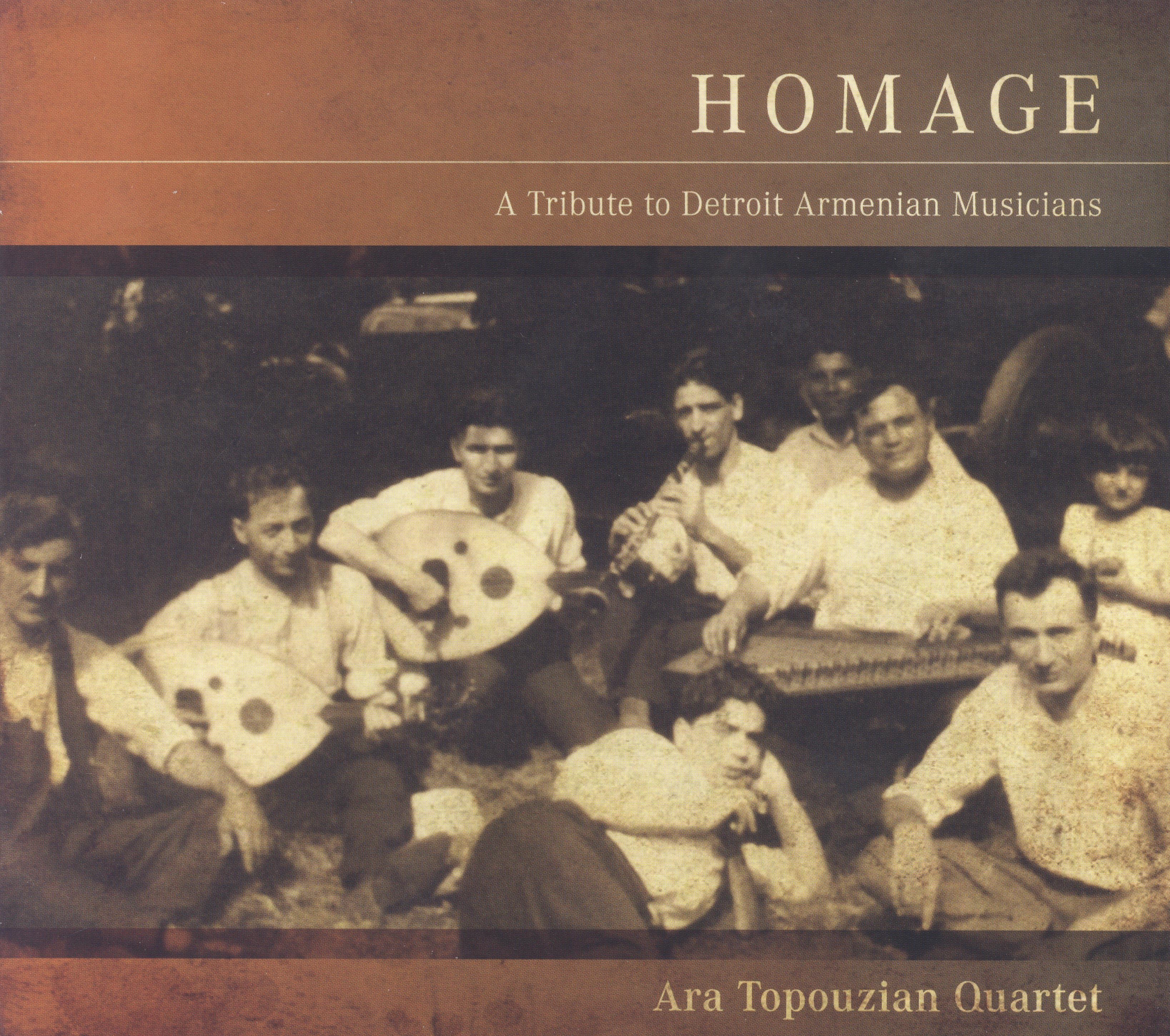
HOMAGE: A Tribute To Detroit Armenian Musicians CD

I have documented in numerous blog essays the making of my film Guardians of Music and I have detailed (probably to exhaustion of my readers) how important creating such a project was for me, especially in the 100th anniversary of the Armenian Genocide.

Continuing this dedication is the release of my latest CD called HOMAGE: A Tribute to Detroit Armenian Musicians. Much of the music on this CD was utilized in the Guardians of Music documentary.

Homage CD Ara Topouzian

CD cover of Homage, released July 17, 2015.

This recording came by accident as it was recorded in 2013, live at a concert at the Charles H. Wright Museum of African American History. An unlikely place to perform Armenian folk music, but a marvelous venue, theater and staff that made me feel welcome just over two years ago. I hope to go back one day for another performance!

There was no intention of releasing the music from that evening until I heard the quality of the recording. It was recorded to a thumb drive and recorded off the sound system. Normally, I like to have archives of my concerts for my own use, but this one was different. The sound quality and the mix of the instruments almost forced me to release this CD. However, I held on to it. (Special thanks to Leon Janikian for mastering the recording and getting it CD replication-ready).

As I was about to go through the process of releasing this CD, I was fortunate to have been awarded a grant from the Knight Foundation. This allowed me to create and complete Guardians of Music. The CD was already mastered and ready for duplication, but instead I concentrated on the documentary.

As I was going through producing the documentary, it became crystal clear that I needed to release the CD as a companion. The design and title of the recording was easy to choose and now HOMAGE is a continuance of the dedication to the immigrant and first-generation Armenian musicians that preserved-by-performance the dance music of the Armenian people.

The CD features some good friends of mine and they delivered a stellar performance, as usual. Along with myself on kanun, I am joined by three talented musicians.

Leon Janikian on clarinet is a friend that I have had the fortune to have recorded with and performed with over the years. A true gentlemen that loves his music and speaks eloquently about what the music means to him as both an Armenian and as a musician.

Mal Barsamian on oud is considered a virtuoso when it comes to Armenian and Middle Eastern music. In recent years, Mal can be seen performing with a wide variety of top Greek music ensembles throughout the East coast. He is not only a master on the clarinet, but his virtuosity allows him to perform the oud like the original Armenian masters such as Udi Hrant Kenkulian.

Michael Shimmin, albeit not Armenian (part Greek!), loves Armenian and Middle Eastern music and at a young age picked up the various ethnic percussion instruments. His understanding and appreciation of the music is essential to this recording and his feeling is heard throughout all of the songs.

The CD is close to an hour of traditional Armenian dance songs, some familiar to many that enjoy Armenian music. As I wrote on the back of the CD, the dedication:

“This album is dedicated to the countless Armenian musicians that kept our music alive. Since the Genocide, it has survived 100 years and God willing, it will never die”.

If you are interested in purchasing a copy of this CD, please click here to visit ARPMusic.com or you can download mp3 files from this site .

Posted in Uncategorized | Tagged , , , , , , , , , , , , , , | Leave a comment

Top Ten Reasons to Support the Arts

1476672_10153547460280175_1443444834_nRecently, I discovered through one of my fellow Creative Many Board members – Americans for the Arts, an organization  that helps promote “cultivate, promote, sustain, and support the arts in America”. What I was intrigued about was their top reasons for supporting the arts.

Typically, I do not like copy/paste other articles in my blog essays, but I will make an exception this time because I feel the reasons warrant inclusion and wide distribution.

10 Reasons to Support the Arts

1. Arts promote true prosperity. The arts are fundamental to our humanity. They enable and inspire us—fostering creativity, goodness, and beauty. The arts help us express our values, build bridges between cultures, and bring us together regardless of ethnicity, religion, or age. When times are tough, art is salve for the ache.

I definitely agree and like that this is the first reason. Using the example of Armenian history, music was that same “salve” that connected us to our history well after the Armenian Genocide. 

2. Arts improve academic performance. Students with an education rich in the arts have higher GPAs and standardized test scores, and lower drop-out rates—benefits reaped by students regardless of socio-economic status. Students with 4 years of arts or music in high school average 100 points higher on the verbal and math portions of their SATs than students with just one-half year of arts or music.

Interesting statistic. A great reason for increased arts and music programs at the elementary level. We speak of STEM (Science, Technology, Engineering and Mathematics) for our children to focus on, which is important, but a balanced program that opens our mind to music and artwork allows for increased creativity which is essential to STEM. 

3. Arts strengthen the economy. The U.S. Bureau of Economic Analysis reports that the arts and culture sector is a $699 billion industry, which represents 4.3 percent of the nation’s GDP—a larger share of the economy than transportation and agriculture. The nonprofit arts industry alone generates $135 billion in economic activity annually (spending by organizations and their audiences) that supports 4.1 million jobs and generates $22.3 billion in government revenue.

Certainly an overlooked industry which includes opportunities for grants to both the organization and artists.  

4. Arts are good for local merchants. Attendees at nonprofit arts events spend $24.60 per person, per event, beyond the cost of admission on items such as meals, parking, and babysitters. Attendees who live outside the county in which the arts event takes place spend twice as much as their local counterparts ($39.96 vs. $17.42)—valuable revenue for local businesses and the community.

When was the last time you visited an art street fair? Several of these artists travel around the state and country promoting their artwork. Support local artists!

5. Arts drive tourism. Arts travelers are ideal tourists, staying longer and spending more to seek out authentic cultural experiences. The U.S. Department of Commerce reports that the percentage of international travelers including museum visits on their trip has grown steadily since 2003 (18 to 28 percent). The share attending concerts and theater performances has grown from 14 to 18 percent since 2003.

Check out your local convention visitor bureau statistics on how the arts affects the overall growth of economic development. 

6. Arts are an export industry. U.S. exports of arts goods (e.g., movies, paintings, jewelry) grew to $75 billion in 2012, while imports were just $27 billion—a $47 billion arts trade surplus.

Great news in real dollars!

7. Arts spark creativity and innovation. The Conference Board reports that creativity is among the top 5 applied skills sought by business leaders—with 72 percent saying creativity is of high importance when hiring. The biggest creativity indicator? A college arts degree. Their Ready to Innovate report concludes, “The arts—music, creative writing, drawing, dance—provide skills sought by employers of the 3rd” Nobel laureates in the sciences are 17 times more likely to be actively engaged in the arts than average scientists.

A great balance between left and right brain can be very productive in the non-art work environment.

8. Arts have social impact. University of Pennsylvania researchers have demonstrated that a high concentration of the arts in a city leads to higher civic engagement, more social cohesion, higher child welfare, and lower crime and poverty rates. The arts are used by the U.S. Military to promote troop force and family readiness, resilience, retention and for the successful reintegration of veterans into family and community life.

I wish this statistic was more visible in the media. Arts can touch every aspect of our lives. 

9. Arts improve healthcare. Nearly one-half of the nation’s healthcare institutions provide arts programming for patients, families, and even staff. 78 percent deliver these programs because of their healing benefits to patients—shorter hospital stays, better pain management, and less medication.

I am a true believer in this and have seen many hospitals incorporate art programs in a variety of ways. As hospitals are looking to shorten bed usages, the arts can and have played a vital role. 

10. Arts mean business. The Creative Industries are arts businesses that range from nonprofit museums, symphonies, and theaters to for-profit film, architecture, and design companies. A 2015 analysis of Dun & Bradstreet data counts 702,771 businesses in the U.S. involved in the creation or distribution of the arts that employ 2.9 million people—representing 3.9 percent of all businesses and 1.9 percent of all employees.

And this number will continue to rise hopefully in the next five years. 

There is a lot of research that is being done on the effectiveness of having a robust arts and culture plan by individual states. Creative Many is one of the leaders (Ok, I am biased a tad as I sit on their board, but they truly are passionate people!) but you can also read what other communities are doing to promote the arts by visiting the ARTS Blog.

Posted in Uncategorized | Tagged , , , , , , , , , , , , , , , , , , , , , , , | Leave a comment

What Happened to Field Trips?

I am a Board member of Creative Many (formerly Artserve) which is an arts and culture economic development organization in Michigan. It is a fantastic organization with a diverse group of Board members that, for the most part, represent different aspects of the art community. We recently held our annual Board retreat which allowed many of us the opportunity to interact with one another on a variety of topics. For me, it was a great to be able to participate in dialogue concerning the direction of the organization.

During our daylong retreat, one of the Board members made a comment which stuck with me the rest of the day. It was a comment that resonated and I felt warranted a blog entry. As we talk about advocating for the arts, he commented about the current demise of field trips as compared to when he was a youth.

It certainly is a scary and realistic thought. Honestly, I do not know to what extent this is true or false as it is represented around the country. In reading some articles online, it certainly exists. This is truly sad to me and I wish it was a non-issue. I even read one article that the field trip is “an incentive for good behavior or good grades”. Really? Enrichment has been replaced by incentives. The field trip has been diminished to the dangling of a carrot in front of the rabbit?

imagesField trips were a part of my youth. Sure, I will be honest, when I was a kid I looked forward to them because it got me out of the classroom – I would expect most children thought the same way. However, the trips were significant. It was part of the curriculum, not an incentive. We did not travel to the amusement park or arcade, we visited the museums, zoo, nature and art centers.

We learned about dinosaurs by looking at models of them and we learned about electricity by creating static electricity. Nature was understood by looking at nature, not a book (What a novelty!) I even remember sitting in an old classroom that Abraham Lincoln once used at Greenfield Village for a full day to experience what children over 100 years ago experienced.

The advantages of field trips for our children are numerous and to me — obvious. Hands-on learning or just experiences of other neighborhoods and environments are more beneficial and create memories for our children.

Sadly, doing an online search of articles on the decline of field trips is plentiful on the web. These articles incorporate several statistics which give legitimacy to the claims that the field trips are in jeopardy. For example, the Field Museum in Chicago used to have over 300,000 students each year and now, they are below 200,000.

The increased decline of this type of invaluable experience, the rapid decay our art museums and other cultural icons will face in the years ahead. I feel these field trips offer the first glimpse of cultural for our children and if they can not experience it as a child – will they ever as an adult?

Posted in Uncategorized | Tagged , , , , , , , , , , , , , , | Leave a comment

Whispers of Ellis Island Revisited

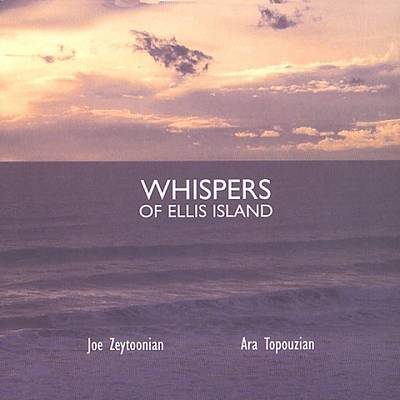
This morning on my way to a seminar I decided to listen to a recording in the car that I made many years ago. As a matter of fact, the album will turn fifteen this July. In 2000, I produced Whispers of Ellis Island master Armenian oudist, Joe Zeytoonian.

CD cover for Whispers of Ellis Island. Available through arpmusic.com

CD cover for Whispers of Ellis Island. Available through arpmusic.com

We spent a considerable amount of time on putting this recording together. It is the perfect album that could have easily been released this year marking the 100th Anniversary of the Armenian Genocide. Everything from the song selections to the name of the album lends itself as a tribute to those that traveled through Ellis Island in order to seek a new life post-Genocide.

Fifteen years ago, world music magazine Dirty Linen said this about our album:  ‘…the feeling of this is quite natural, in keeping with this tribute to their ancestors’ travails.’

I forgot some of the nice work we both did on this CD. I certainly appreciate the work and dedication Joe had with this project. I remember him pushing me harder to get certain notations correct and we used a variety of rhythms. Songs like Air and Reckless were written by Joe and really allowed me to think differently about music.

In the liner notes, we end with: Through danger, hardship, and heartbreak, Armenians transported their spirit through Ellis Island and gave us life and music. Thanks to the mothers and fathers.

Posted in Uncategorized | Tagged , , , , , , , , , , , | 1 Comment

Think Like An Artist

Over the weekend, my family and I visited downtown Farmington, Michigan for the annual Art on the Grand, which is an artisan festival that I am sure we have all experienced in in one fashion or another in our communities. Tents with local artists exhibiting and selling their works of art to the public. You have to admire each of the artists conviction and endurance in exhibiting in this manner. These shows are not easy for artists and in many cases this is how they make their livelihood.

IMG_5834

The inside of the mobile cart classroom from Art on the Grand.

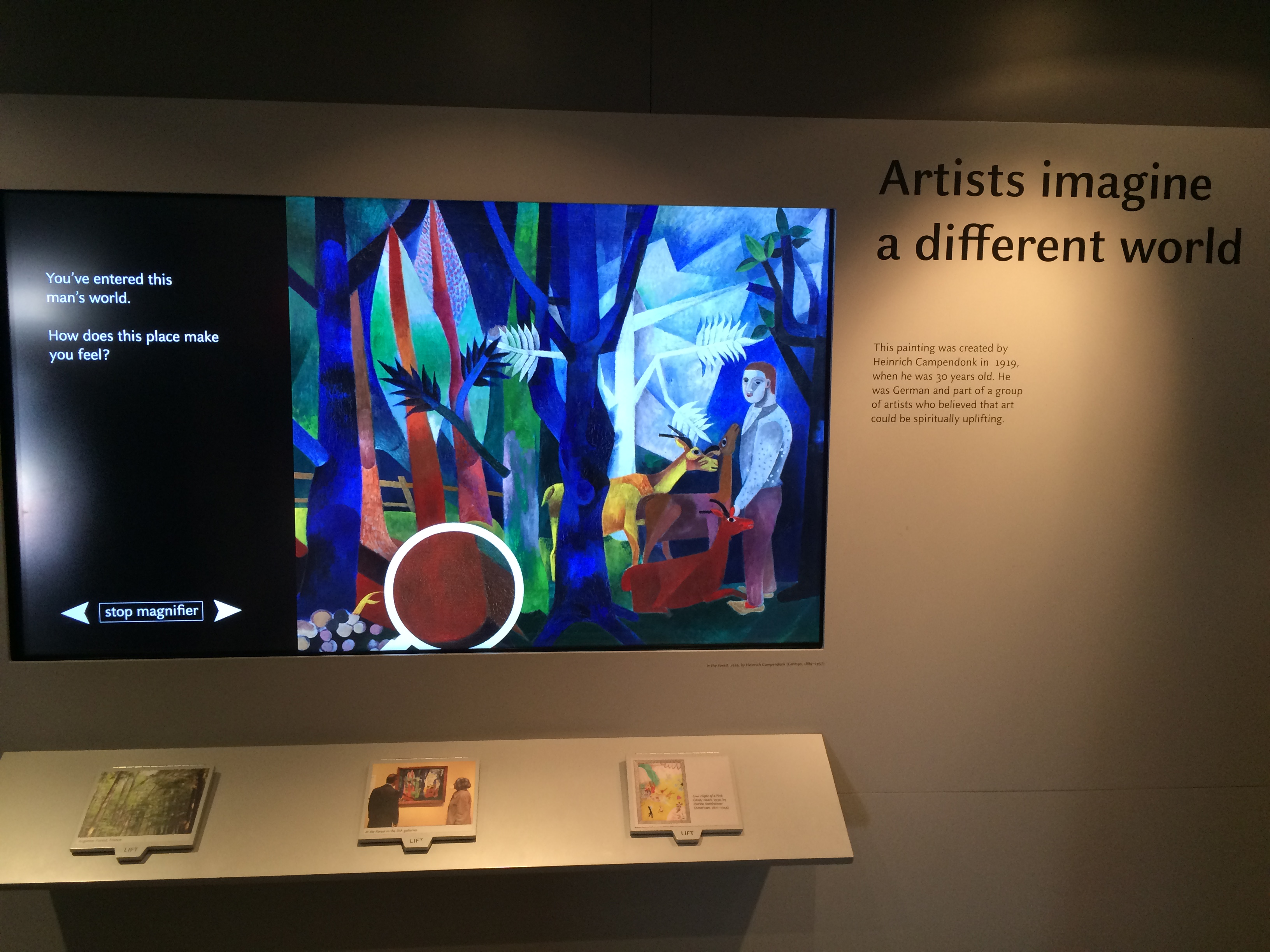
One of the new additions for this years festival was the DIA Away: Think Like an Artist, a free, mobile interactive classroom. A very welcomed and popular mobile art classroom.

This is a fully furnished, vibrantly designed 53’ double-expandable trailer that will provide a rich educational program beyond the museum’s walls. Inside, participants will discover some of the ways artists think and then have the opportunity to try out creative thinking skills at digital and hands-on stations.  (DIA Away website description of mobile classroom)

IMG_5832

The interactive stations allowed adults and children to experience art on their terms.

I applaud the Detroit Institute of the Arts (and their community relations department!) for once again bringing art out to the communities. This was an excellent opportunity to demonstrate and teach to all ages the importance of art. It allowed children to interact with digital media and get them excited about art.

I watched as several people walked out of the trailer thoroughly impressed by what they experienced – in many cases, most had no idea what they would see.

A brilliant marketing move was to add a video booth in this mobile classroom, allowing participation to record a message for the DIA. I happily contributed! Here is what I said on camera: 

Posted in Uncategorized | Tagged , , , , , , , , , , , , , , , , , , , | Leave a comment

Lasting Impressions

When I compose these blogs or short essays, sometimes I have great difficulty in coming up with the perfect title. Sometimes I end up changing the title several times before I finalize on one and even then, I end up not liking what I have used.

I start with a working title and as I move through my piece, I seem to change the title to fit the content of the blog. For example, the title I used in writing the first few paragraphs is Connecting. Lets see what I call it by the end of this piece.

Some say titles are not important and I would tend to agree with that statement, however, there are times that a title is no different than a first impression. Ah, maybe I need to change this blog title to First Impressions? For now, I will stick to Connecting. Lets see where this goes.

first-date

First date impression?

I am a firm believer in first impressions. Very rarely have I been misguided by a first impression. You can witness first impressions of a person, a book, song, or even a movie. They are significant to me, sometimes to a fault. This is not an exact science and it is more of a personal preference or observation. Even on Facebook, reading certain postings, you tend to get an impression which may not be favorable of that individual.  Too me, a first impression is substantial and very difficult for me to give a second chance. I have to agree with Oscar Wilde when he said “My first impressions of people are invariably right”.

When I was working on my documentary, Guardians of Music, I used a working title of Detroit Hye Times. I used it on everything pertaining to the documentary.  I talked about how I came to to the new name of Guardians of Music, but what I didn’t elaborate on was the pain it took in finding the perfect title for this documentary. I am very happy with the name as it perfectly describes the nature of my documentary.

A frequently referenced quote by William Shakespeare was “A rose by any other name would smell as sweet”.  I referenced this quote in a past essay, but it is worth mentioning again. The quotes meaning suggests that a name doesn’t matter as much as what an object or person really is about. Sure, that makes sense. Another overused quote “never judge a book by its cover” comes to mind.

Musically speaking, the name seems to matter much less as the hope is that the listener is hearing the music because it recognizes the artist or its material. However, how often have we purchased music thinking it was going to feature a certain style of music and then we get something totally different? I can give you many examples of that, but I wont “out” any musicians in this blog. Lets simply say that sometimes it makes sense to have the proper name or title when portraying what you wish the viewer or listener to become engaged.

I just changed the title to Lasting Impressions. See, I told you it would happen.

The best part? I intended to start this essay about an entirely different topic.


Posted in Uncategorized | Tagged , , , , , , | Leave a comment

Michelle Andonian: ‘Hope Dies Last’ project

754580

William Saroyan

Legendary Armenian author William Saroyan once said “I should like to see any power of the world destroy this race, this small tribe of unimportant people, whose wars have all been fought and lost, whose structures have crumbled, literature is unread, music is unheard, and prayers are no more answered. Go ahead, destroy Armenia . See if you can do it. Send them into the desert without bread or water. Burn their homes and churches. Then see if they will not laugh, sing and pray again. For when two of them meet anywhere in the world, see if they will not create a New Armenia.” 

To the Armenians, this is a very famous quote. Some have even said it is an overused quote, but it rings true for us as Armenians and I think it will remain a timeless quote. The most poignant portion of this quote to me (and I think to most Armenians) is “For when two of them meet anywhere in the world, see if they will not create a New Armenia.” I have witnessed this time and time again.

1392d89

Michelle Andonian

As a musician, I had the ability to identify with this quote once again last week when I had a chance to get together with famed Detroit photographer Michelle Andonian. If you don’t know Michelle, she is a remarkable woman with an endless impressive resume of accomplishments. Her work has appeared around the globe and her photographic eye is amazing. I have always enjoyed her work and for the first time I had a chance to sit and chat “shop” with her about my film documentary and her latest project. We are both recipients of a Knight Foundation grant.

The conversation for me was very inspiring. I felt an immediate connection and she provided some great feedback and encouragement for me as an artist.

As you can see, Saroyan’s quote ran deep that day. We share some of the same passions and dedication towards our Armenian ancestry, but we also share the importance of presenting our art forms the best way we know how. To me, this is equally important.

I have said time and time again, becoming a Kresge fellow was so much more than the cash prize, it was validation. Michelle knew exactly what I meant.

Michelle has a great project worth noting in this blog. The Knight Foundation also felt it was a great and worthwhile project to support. It is called “Hope Dies Last” and through a book of photos and essays surrounding the 100th anniversary of the Armenian Genocide, Michelle sums it up nicely “Someday they will recognize what happened to us; not during my lifetime, but someday.”

She will unveil a book (her cousin journalist Bob Ourlian, Wall Street Journal is writing the essay portion) this coming September with subsequent public exposition. More importantly, please consider financially supporting her project. Its important — to her, the world of art, and an Armenian legacy. We produce these projects not for the accolades, but we know we need to leave behind something for the next generation.

Read more about her project by clicking here.

Posted in Uncategorized | Tagged , , , , , , | Leave a comment

Afterlife of Guardians of Music

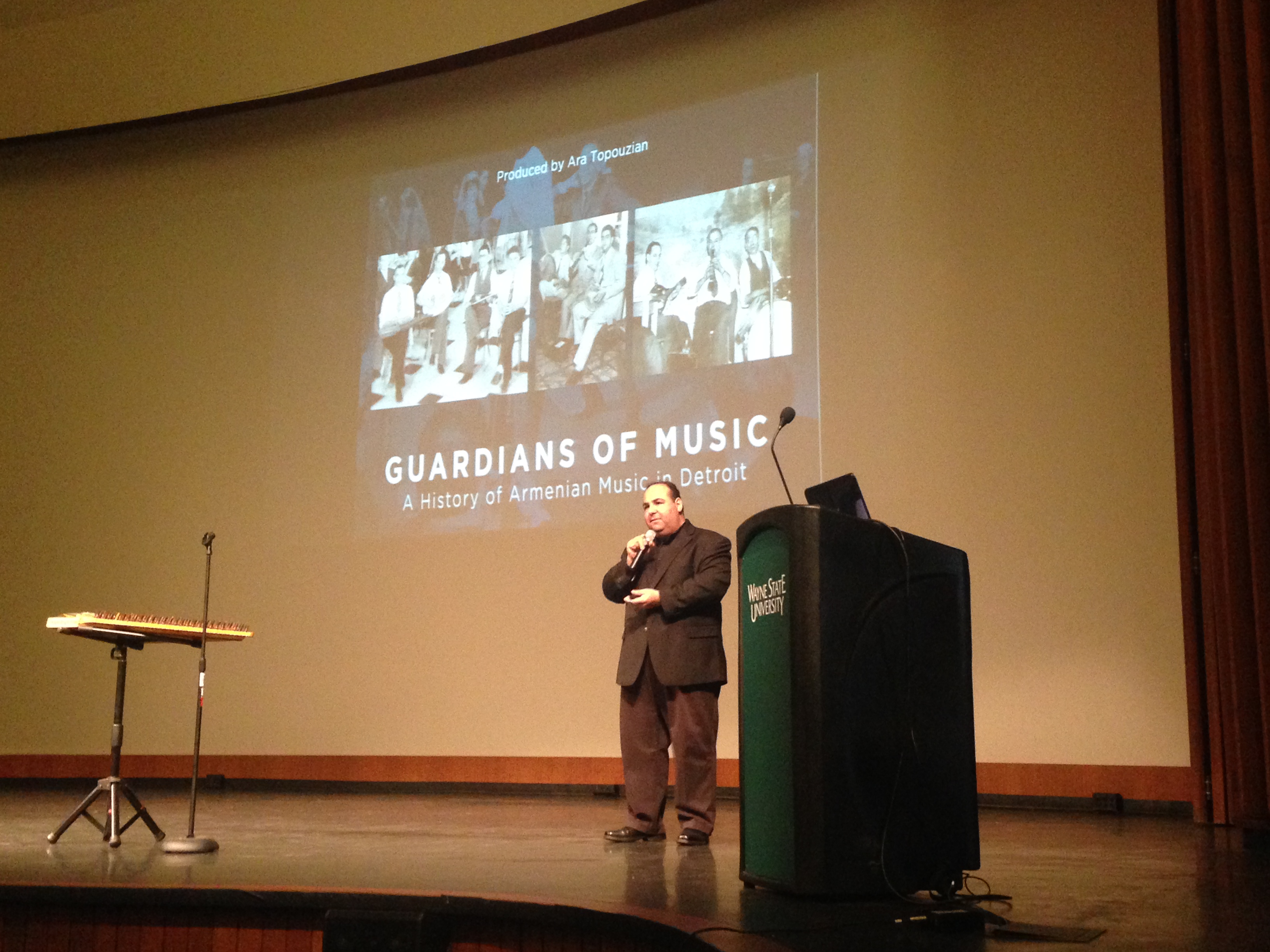
A few months ago, I mentioned in a previous blog essay that I had the opportunity to “fill in” for a presentation (Armenian History through Music) that took place at Wayne State University, part of several ongoing events commemorating the Armenian Genocide. The program discussed how Armenian music is important to our history and how it related to Genocide.

IMG_2568

Here I am talking to the audience at Wayne State University this past April.

My presentation covered some of the highlights of the making of Guardians of Music. It was the first time I had talked about the documentary post airing on PBS. Oddly enough, it seemed different for me this time. I have talked about the making of this film several times, but now as it was post-premiere, the tone for me seemed different. It was more personal and even emotional.

My presentation included photos used in the documentary and for the first time, I found myself referring to them differently as I did prior to the airing of the film. Enough time had passed for me to fully realize what kind of an impact this documentary made on the community and its relevance to the Armenian Genocide anniversary.

Please don’t misunderstand me, this isn’t ego talking, as a matter of fact, I think I have stated before that I was unsure if my documentary would be perceived favorably or not.

What I found myself doing was referencing the photographs differently from the past. Instead of simply mentioned musician names and their style or brand of playing — I talked about what I knew of them as a family man and what their backgrounds were in historic Armenia.

I talked for sometime about how they never realized the importance their playing made within the Detroit community. How they preservation of music was instrumental (pardon the pun) and how they need to be remembered and in many cases – revered.

How 100 years later, their music is still heard.

I hope the afterlife of Guardians of Music lasts a long time. These musicians and their contribution should live forever.

Posted in Uncategorized | Tagged , , , , , , | Leave a comment